If you asked most rowers what powers a stroke, the instinctive answer is “legs and back.” Arms come third, and the core rarely gets mentioned at all — yet it’s the core that decides whether all that leg drive actually reaches the blade, or leaks away before it gets there.
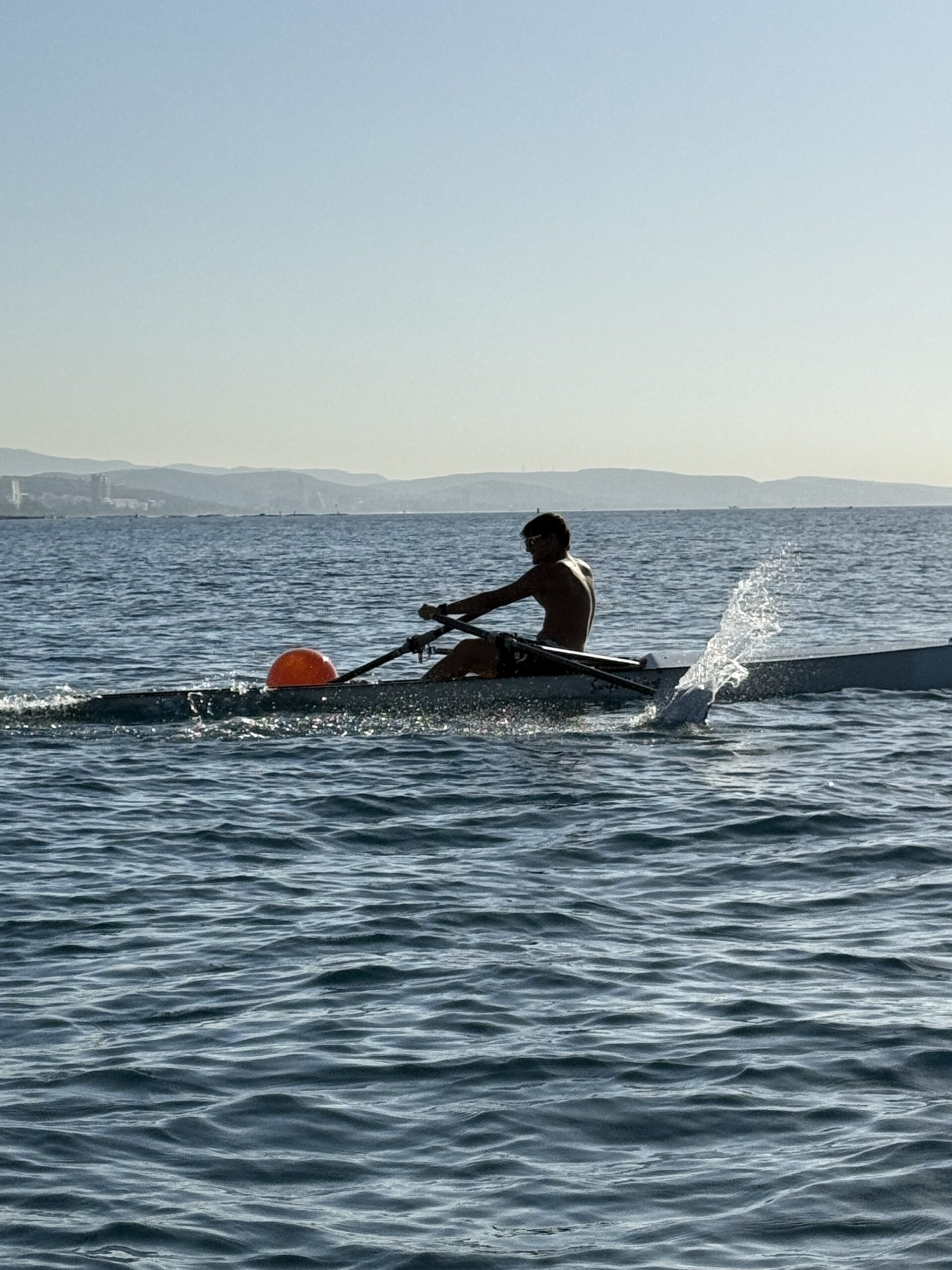
This is especially true in coastal rowing, where the boat rarely sits still. Chop, swell, and wind push and twist the hull under you with every stroke, and it’s your trunk — not your arms — that has to absorb and control that movement while still delivering power.
The Core as a Transmission Line
Think of the rowing stroke as a chain: legs generate force, the trunk transmits it, and the arms and blade deliver it to the water. If any link in that chain is weak, force gets lost — usually at the hips and lower back, where an unstable core lets energy dissipate instead of transferring cleanly through to the oar.
A strong, well-controlled core keeps the spine in a stable, neutral position through the drive, so the power generated by the legs travels through the trunk almost undiminished. Without that stability, part of every stroke is wasted compensating for a trunk that’s collapsing or twisting instead of holding its line.
Why Coastal Conditions Raise the Stakes
Flat-water rowing already demands core control. Coastal rowing multiplies the demand, because the boat is constantly being displaced by waves and cross-currents. A rower with a stable core can absorb that instability through the trunk while keeping the stroke rhythm and blade work clean. A rower without it ends up fighting the boat instead of the water — over-gripping the oar, losing balance mid-drive, or rushing the recovery to regain control.
Over a long coastal session, that difference compounds. Core fatigue shows up as technique breakdown: shortened strokes, inconsistent blade depth, and a slow leak of boat speed that has nothing to do with fitness and everything to do with trunk control running out before the legs do.
Training the Core for the Boat, Not the Mirror
Not all core work translates to rowing. Classic isolated exercises — crunches, sit-ups — train flexion in a way the stroke rarely uses. What matters for coastal rowing is anti-rotation and anti-extension strength: the ability to resist unwanted movement while still producing force through the legs and hips.
That means:
- Anti-rotation work (e.g. Pallof press, single-arm carries) to resist the twisting forces waves introduce mid-stroke
- Anti-extension work (e.g. planks, dead bugs, ab wheel) to keep the lower back stable under load rather than arching or collapsing
- Hip-hinge integration (e.g. deadlifts, good mornings) so the core learns to stabilize while the legs — not the back — do the driving
This is exactly the logic behind the foundational movement work in Move&Row’s training progressions: core stability isn’t trained in isolation for its own sake, but as the connective tissue between leg drive and blade work — the piece that makes every other part of the stroke actually count.
The Takeaway
In coastal rowing, the core isn’t a supporting actor — it’s the stabilizer that lets the legs’ power and the arms’ technique actually show up in boat speed. Waves will always try to move the boat under you. A trained core is what keeps the stroke, not the sea, in charge.
The basic excercises for The Core https://moverow.eu/tag/core/